Business experiments
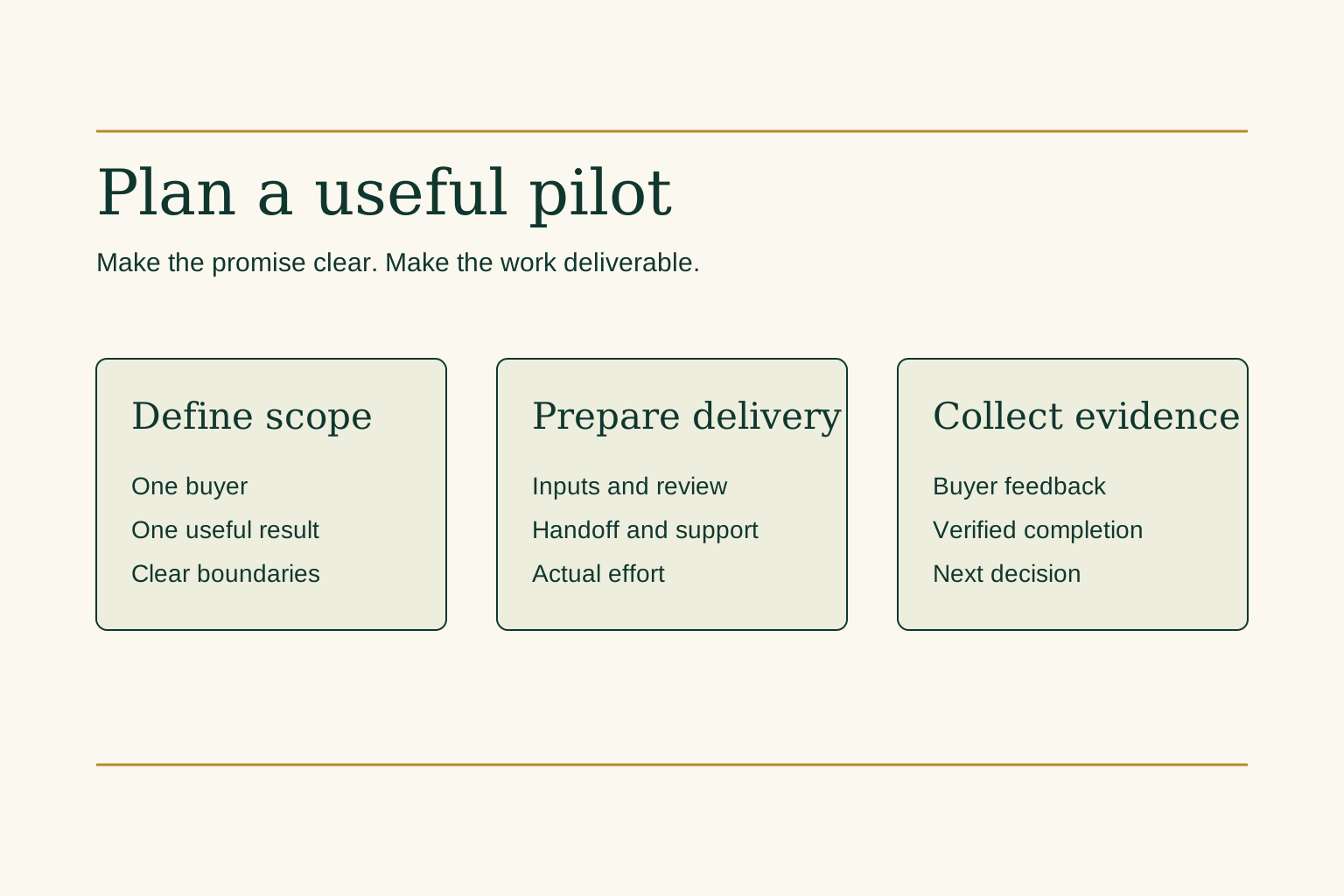
A sellable pilot needs a delivery plan before a checkout link
Turn a promising service idea into a bounded pilot with clear scope, buyer evidence, delivery steps and a realistic review decision.
In this guide
- The useful starting point
- Write the offer in one paragraph
- Check the problem before expanding the package
- Walk through delivery from start to finish
- Use a cost worksheet without pretending it is demand
- Set the next decision in advance
- Find freelance help for the part you cannot responsibly deliver
- Freelance while you build the bigger idea
- Decide whether to do, learn, or delegate
- Sources and further reading
The useful starting point
Name one buyer and one useful deliverable, check the problem with real people, and define how you will deliver, support and review the work. A checkout link proves that payment can be requested; it does not prove demand or fulfillment.
A small service can be easier to test than a large product, but it still needs an operating plan. Before adding a payment button, describe the promise in a way that you and a prospective buyer can both understand. The first experiment should reveal whether the problem matters and whether you can deliver useful work.
Write the offer in one paragraph
Identify the buyer, their situation, the deliverable and the boundary. A fictional offer might be a review of one newsletter signup journey, ending with an evidence sheet and three prioritized fixes. It should say whether implementation is included, what access is required and what the buyer will need to do.
Avoid promising a revenue increase or a specific number of subscribers. Those outcomes depend on factors the pilot cannot control. A clear deliverable and a defined review process are easier to assess than an ambitious growth claim.
Check the problem before expanding the package
Ask prospective buyers how they handle the problem today, what happens when it goes wrong and what they have already tried. Keep their actual words separate from your interpretation. Interest in a topic is different from willingness to pay for your proposed scope.
Use AI to organize authorized, anonymized research notes. Ask it to identify contradictory evidence and unanswered questions. Do not let a generated customer persona stand in for a person you have spoken with. The idea revival worksheet helps reduce a broad possibility to a testable question.
Walk through delivery from start to finish
- Intake: what information is essential, and where will it be stored?
- Preparation: what must be checked before work begins?
- Work: what steps produce the deliverable, and which require human review?
- Handoff: how does the buyer receive and understand the result?
- Support: what questions or corrections are included, and who owns them?
Try the process with a clearly labeled internal example. Record setup, review, correction and administration time as well as the main work. A short task can become an expensive offer if the handoff repeatedly fails.
Use a cost worksheet without pretending it is demand
List the tools you actually need, the direct delivery costs, any payment fees under your current account terms and the effort you expect to spend. Mark estimates as estimates. A proposed price is a hypothesis until a real buyer agrees to it, and gross receipts are not profit.
Keep the first scope narrow enough to revise. If the economics only work when every buyer needs no support, investigate that assumption before selling. The workflow run log can help you record actual effort consistently.
Set the next decision in advance
Choose what would make you continue, change the scope or stop. Useful signals include a buyer describing an urgent problem, agreeing to a clear pilot, receiving the promised result and explaining what was valuable. Page views and a working checkout are different signals.
Write a short pilot note: buyer; problem; deliverable; excluded work; intake; reviewer; delivery method; support boundary; expected effort; evidence; next decision. Preserve uncertainty when a question is unanswered.
Use the project planner to choose a manageable next step, or review ways to work with Ashley when you want guided support. Keep your first offer small enough that its real delivery teaches you what to build next.
Find freelance help for the part you cannot responsibly deliver
A small paid pilot can expose a real capability gap. Before hiring, decide whether the task needs a specialist, whether the customer permits subcontracting, and whether the pilot budget covers briefing and review. Keep customer accountability with you; do not promise expertise you have not secured.
Affiliate disclosure: We may earn a commission if you become a qualifying Upwork customer through this link.
Explore hiring on Upwork. Compare relevant work, agree on a small paid milestone, and review the deliverable before expanding the project. Marketplace access does not guarantee a suitable hire or business results.
Freelance while you build the bigger idea
A scoped service can be a useful experiment while you develop a product or business. Choose work you can deliver with current skills: editing client-owned content, organizing approved data, designing a small workflow, or implementing a narrow feature. Keep time for your own project visible on the calendar and cap the number of engagements you accept.
Build an honest sample, describe the inputs and finished output, and account for briefing, revisions, administration, and software costs. Use referrals, relevant communities, and marketplace research to understand demand. Do not treat an advertised project budget as money you will earn, and do not promise clients results you cannot control.
Decide whether to do, learn, or delegate
Do work you can check reliably. Learn a missing skill when the practice itself serves your goal and the risk is manageable. Hire a specialist when a specific gap justifies the cost and you can evaluate the handoff. If the work belongs to a client, agree on subcontracting and data access first. The Upwork recommendation above is for hiring a collaborator; it is not a link promising freelance income.
Review the experiment weekly: what people asked for, what they paid for, the time and expenses involved, and whether the work left room for the business you are trying to build. More work is not automatically progress toward that goal.
Sources and further reading
Sources checked October 18, 2026. Review the linked publisher information for current details.
Put one idea to work
Use the idea revival worksheet to turn a recurring interest into a small test with a clear decision.
Choose an idea worth testing →Explore more from Wealth ExperimentGet the Wealth Experiment field notes →Keep practicing
 Choose & test an idea
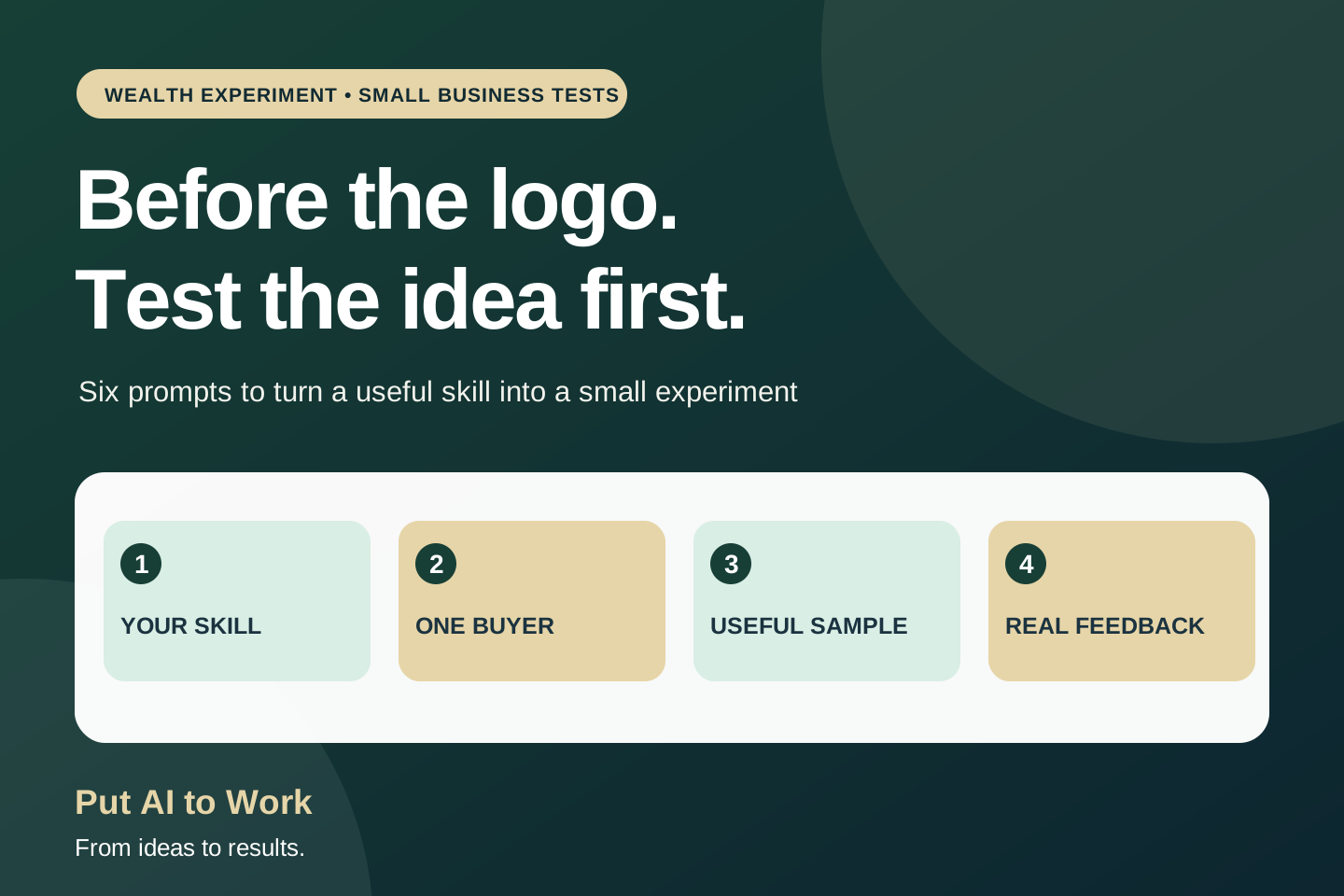
Before the Logo, Before the Website: 6 AI Prompts to Test Your Side Hustle
Six hands-on AI prompts to test a side-hustle idea before spending weeks on a name, logo or website. Find a buyer, create a sample and learn from real feedback.
October 24, 2026 · 12 min read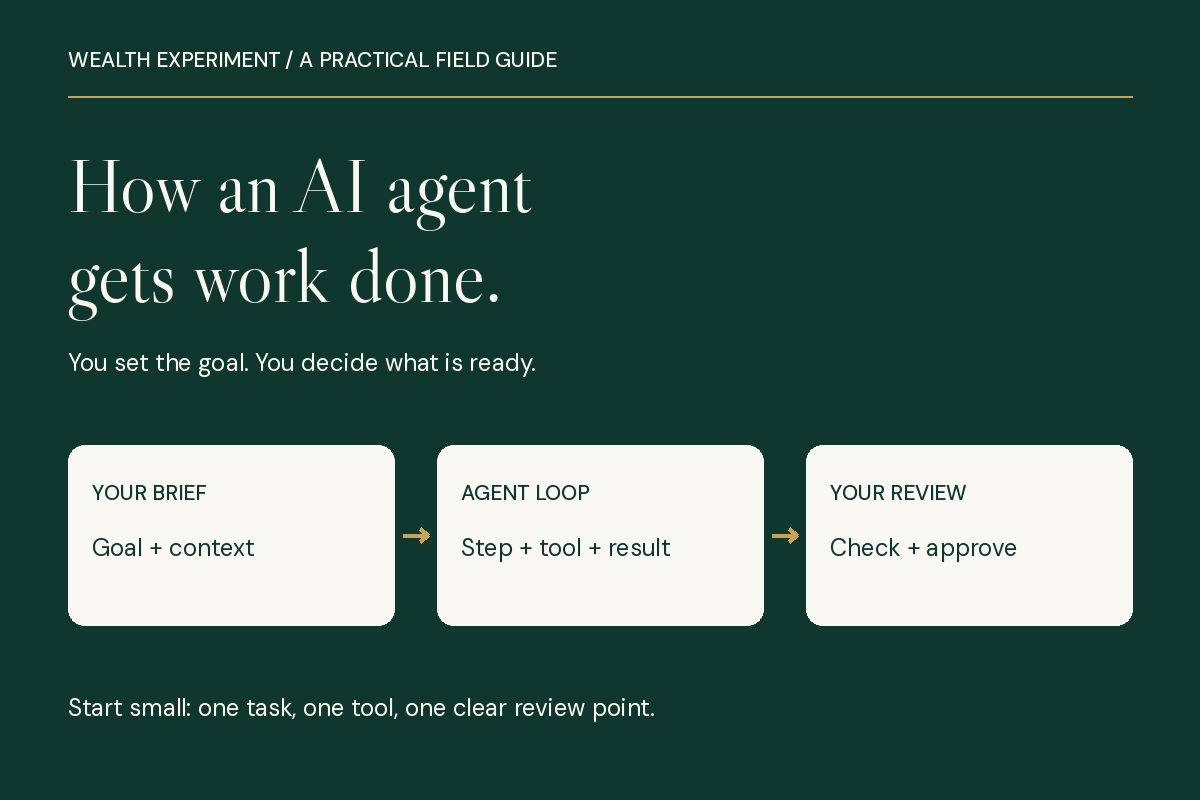 AI agents · A practical field guide
How AI agents work—and where to start
Give an agent one useful job. Understand the loop, harness, tools, plugins, tokens, and human checkpoints—then try a workflow for your day, your work, or a small service.
October 24, 2026 · 11 min read