
Your outcome
What you will have at the end
Leave with one experiment card, a realistic sample, a bounded offer, a plan to reach relevant people, and a decision method that accounts for your time and costs.
Bring these starting materials
- A skill you can deliver reliably, including the parts you must personally review or cannot responsibly offer.
- A specific customer group you can reach through appropriate relationships, communities, or an existing audience.
- Observed problems, voluntary conversation notes, or public sources that you can separate from your assumptions.
- A written time limit, cash limit, review date, and simple record of activity, responses, delivery effort, and costs.
Choose a small, useful toolkit
One assistant and a clear review process are enough to begin. Add a tool only when the next task requires it. Software subscriptions and setup are separate from these free guides.
Research and organize
Your AI assistant and original sources
Organize evidence and unanswered questions. Check original sources before treating a claim as a fact.
Make the sample
Tools suited to the deliverable
A document may be enough for a proposal pilot. Choose tools that help produce and review the promised work.
Record the experiment
A spreadsheet or simple log
Keep counts, dates, hours, costs, and outcomes together so you can explain the eventual decision.
One example, carried through the process
Build along: a proposal-preparation pilot
This hypothetical service prepares proposal first drafts for independent consultants using their approved notes and materials. It is a teaching scenario, not an available service or a report of demand, sales, or earnings. Replace the illustrative statements with evidence from your own situation.
You can run these roles in one assistant or delegate them when your tools support it. These guides teach the process; reading or copying a prompt does not connect accounts or start an agent.
You + research assistant
Find a reachable buyer
Name a buyer, a recurring task, and a realistic access route. Your skills and evidence about their current work give the experiment a practical starting point.
What to do
- List tasks you can complete to a useful standard. Pair each with a specific customer and the situation that makes the task important; include your delivery limitations.
- Collect observations about current behavior: what triggers the task, how it is handled, where effort accumulates, and what happens when it goes badly. Preserve the source and context.
- Separate facts, interpretations, and unknowns. Ask AI to organize the notes and suggest research questions, then choose the buyer you can actually learn from.
See what good work looks like
Narrow the buyer before designing the offer
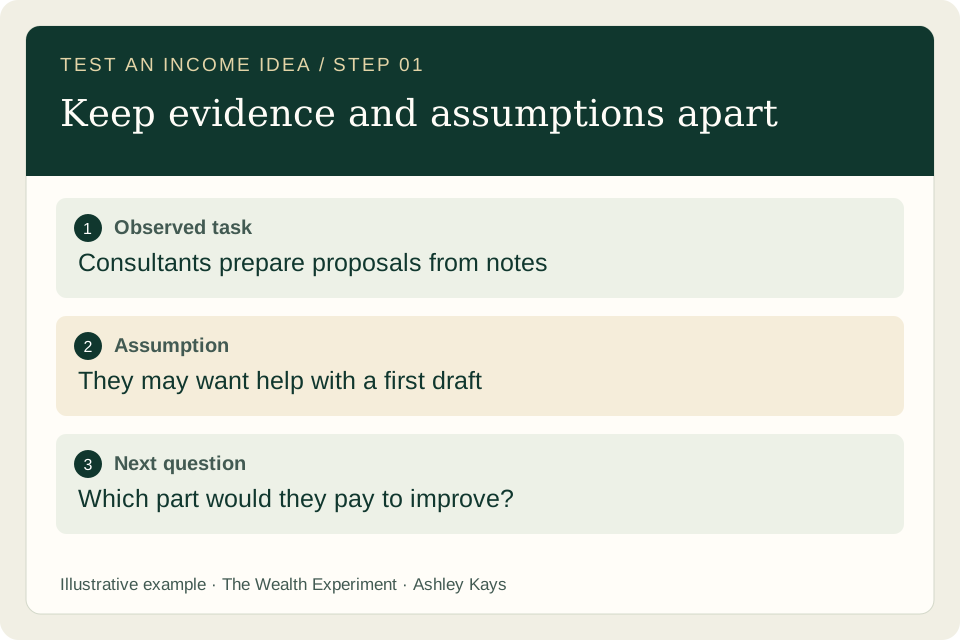
“Anyone who needs sales help” is too broad for this sample. A more useful starting group is independent consultants who prepare proposals from discovery-call notes and existing service descriptions.
The research questions are concrete: how often do proposals arise, which parts take work, what information must remain private, and who approves the final document? Repeated proposal writing may be observable; willingness to pay for outside preparation remains a separate question.
Copy the prompt for this step
Replace the bracketed details with your own project. Review what the assistant returns.
Use my skills [skills], access routes [routes], and observations [notes] to compare three possible buyers. For each, list the task, supporting evidence, missing information, and a practical way to learn more. Separate facts from assumptions. Do not invent customer quotes, demand estimates, or market size.
Before you move on
- The buyer describes a recognizable group and situation.
- At least one realistic access route is identified.
- Unknown demand is still labeled unknown.
Keep this output: A buyer shortlist with sources, access routes, and questions worth investigating.
If you get stuck: An AI-generated persona can suggest questions, but it cannot establish that real customers have the problem or want your offer.
Product assistant + you
Choose the risky assumption
Match the test to the uncertainty. A conversation can reveal workflow problems; a defined paid pilot can test a purchase decision. Choose the important question first.
What to do
- List what must be true: the buyer has a relevant problem, you can reach them, the offer is understandable, they will agree to terms, and you can deliver sustainably.
- Choose one assumption and match the test to it. Write what you will show, who will see it, and what observable action would change your confidence.
- Set cash and total-hour limits, a review date, and continue/change/pause criteria in advance. Include preparation and follow-up time so the limit reflects the whole experiment.
See what good work looks like
An experiment card with a clear question
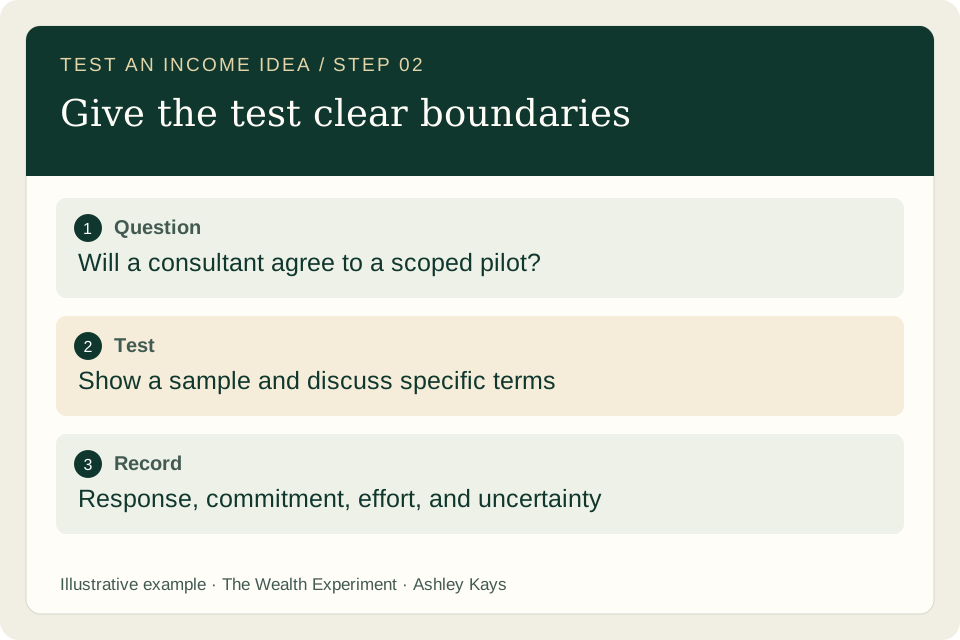
Sample question: will a relevant consultant with an upcoming proposal consider a clearly scoped preparation pilot after inspecting a sample? The test is a direct conversation and a specific offer, not an app build.
Illustrative boundaries are 14 calendar days, 10 total hours, and a $50 cash cap; choose limits that fit your circumstances. A meaningful commitment is agreement to a defined pilot and its terms. Praise, curiosity, and an accepted paid engagement belong in separate evidence categories.
Copy the prompt for this step
Replace the bracketed details with your own project. Review what the assistant returns.
Identify the riskiest assumption in this idea [idea]. Design one small test using my buyer access [access] and limits [limits]. Specify the artifact, audience, primary observation, denominator, review date, and continue/change/pause rules. Explain what the test cannot establish and which alternative explanations to consider.
Before you move on
- The proposed test addresses the chosen uncertainty.
- The evidence rule describes an observable action.
- Limits include selling, delivery, and review effort.
Keep this output: One experiment card with a question, test, limits, evidence rule, and review date.
If you get stuck: Do not change the success rule after seeing the result. Record a revised hypothesis as the next experiment instead.
Delivery assistant + you
Make a small sample
A representative sample helps someone evaluate the offer. Rehearsing it also reveals missing inputs and delivery problems before you make a customer commitment.
What to do
- Build one representative deliverable using fictional or authorized inputs. Include enough detail to demonstrate your judgment and quality without pretending it was completed for a real client.
- Describe the offer's boundaries: required inputs, exact output, turnaround to agree, revisions, exclusions, and acceptance criteria. Identify any work that requires specialist knowledge you do not provide.
- Run the delivery process yourself and record the effort, including review and correction. Improve the sample until you can explain how you would produce comparable work again.
See what good work looks like
A proposal draft with useful boundaries
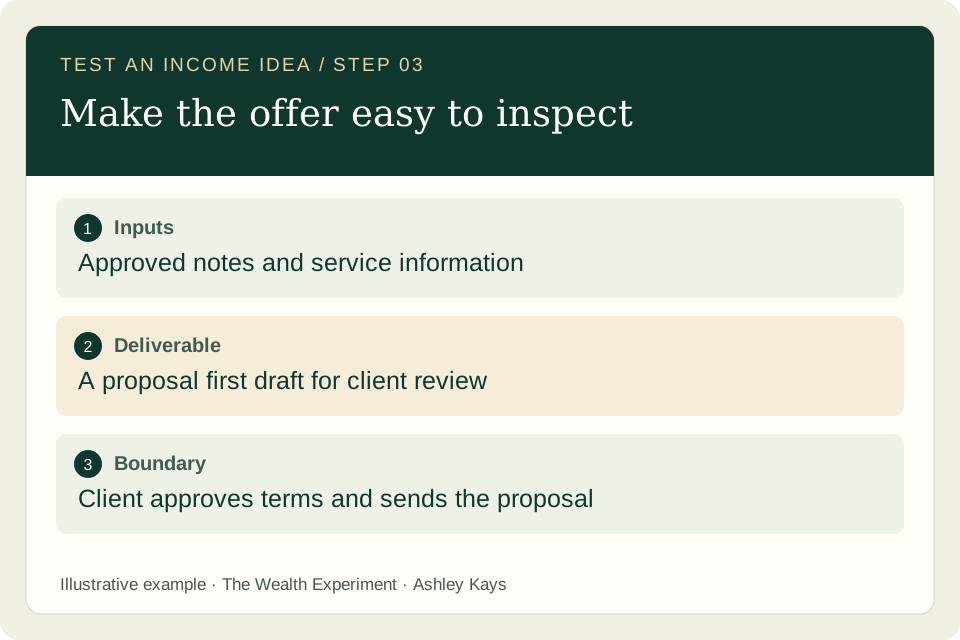
The sample includes a project summary, proposed scope, deliverables, assumptions, and questions for the consultant. It uses fictional source notes and marks information that the consultant must confirm.
The offer covers organizing approved material into a first draft and one agreed review round. The consultant owns commercial terms, factual approval, and the final send. Legal advice, invented credentials, and guaranteed sales outcomes are outside the service. Any sample price is a hypothesis until terms are agreed.
Copy the prompt for this step
Replace the bracketed details with your own project. Review what the assistant returns.
Create a sample deliverable from these fictional inputs [inputs]. Preserve the stated facts and mark missing information. Then draft an offer with client inputs, deliverables, exclusions, review steps, and acceptance criteria. Identify delivery risks and questions to resolve before I make a customer commitment.
Before you move on
- A buyer can tell exactly what they would receive.
- Sample data and unresolved details are clearly marked.
- You can perform and review the promised work.
Keep this output: A clearly labeled sample, a bounded offer, and a rehearsed delivery checklist.
If you get stuck: A beautiful sample does not prove that delivery is repeatable. Rehearse the work from fresh inputs and include corrections in the effort log.
Marketing assistant + you
Run one distribution test
A test needs relevant people to encounter the offer. Choose one appropriate channel so you can understand who saw it, what they were offered, and how they responded.
What to do
- Choose a channel that fits your buyer access: existing relationships, a relevant community that permits the activity, or a useful demonstration for your audience. Respect the channel's expectations.
- Prepare a clear invitation that identifies the problem, sample, proposed next step, and any pilot terms. Review the exact message and recipient before sending or publishing it.
- Track the date, channel, relevant reach where known, responses, conversations, and commitments. Use aggregate or minimal personal information and preserve the difference between observed counts and estimates.
See what good work looks like
A draft invitation someone can evaluate
Example wording: “I'm testing a service that turns a consultant's approved notes into a proposal first draft. I have a fictional sample showing the format and review process. If proposal preparation is a current bottleneck, would you be open to a brief conversation about whether a scoped pilot would help?”
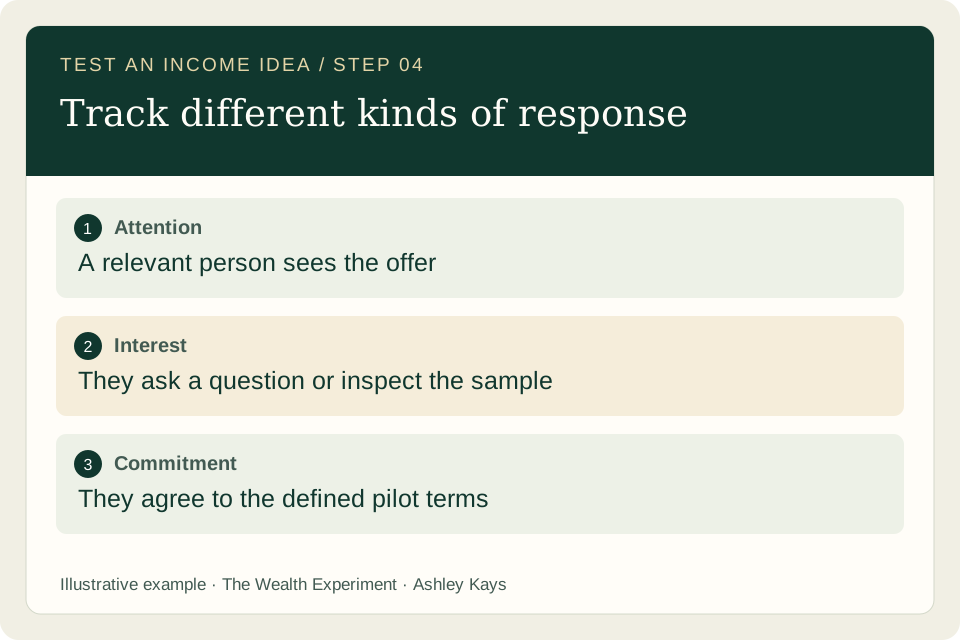
Adapt the message to a relevant relationship. A reply requesting the sample is interest; a conversation is a deeper signal; agreed pilot terms are a different event. Record each accurately and respect a decline.
Copy the prompt for this step
Replace the bracketed details with your own project. Review what the assistant returns.
Draft a short invitation for this buyer [buyer], channel [channel], offer [offer], and sample [sample]. State the pilot honestly, avoid unsupported claims, and give one clear next step. Then propose a simple tracking table that separates relevant reach, replies, conversations, commitments, and completed work.
Before you move on
- The audience is relevant to the offer.
- The message matches the scope you can deliver.
- Counts use consistent definitions and denominators.
Keep this output: Reviewed invitations or a demonstration, plus a dated record of relevant exposure and responses.
If you get stuck: Silence has several explanations. Check relevance, delivery, timing, and clarity before concluding the problem does not matter.
Delivery assistant + quality reviewer
Deliver and count the costs
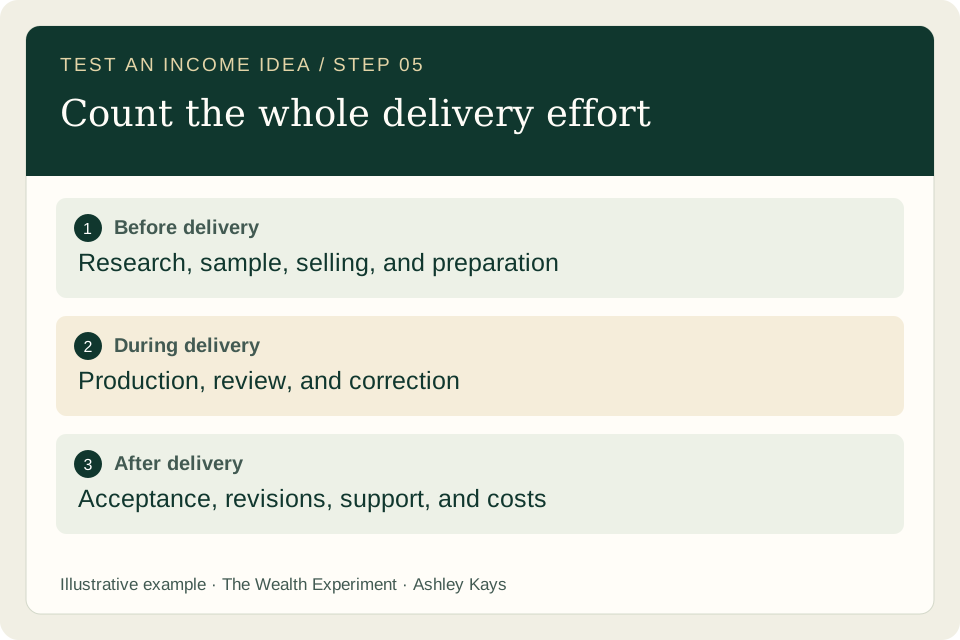
A purchased pilot is useful evidence only when you understand the work required to fulfill it. Keep a record of delivery quality, customer acceptance, cash movement, and the full effort behind the result.
What to do
- Before starting, confirm scope, inputs, price, timing, review arrangements, and what acceptance means. Use only customer information you are authorized to process in the chosen tools.
- Follow the delivery checklist and review the output against the source material. Record defects, revisions, customer questions, and the final acceptance decision rather than counting an unfinished draft as delivered.
- Log setup, research, selling, production, review, revisions, and support time. Record cash received, direct expenses, refunds, and shared costs consistently; keep pending amounts separate.
See what good work looks like
Make the effort visible
For the proposal pilot, the ledger includes preparing the fictional sample, discussing fit, clarifying source notes, producing the draft, checking every claim, and handling the agreed review. Failed attempts still belong in the record.
Subtract direct cash costs and refunds from gross collected revenue to describe contribution before other overhead and tax. Do not subtract refunds twice if receipts are already net. Record total human hours separately. Explain any allocation of shared subscriptions or setup effort so later comparisons stay consistent.
Copy the prompt for this step
Replace the bracketed details with your own project. Review what the assistant returns.
Audit this experiment ledger [ledger]. Separate collected revenue, pending amounts, direct costs, refunds, shared-cost allocations, and all human hours. Show the arithmetic and flag missing categories without treating missing values as zero. Summarize delivery acceptance and unresolved defects separately from financial observations.
Before you move on
- The customer has accepted the agreed work or gaps are recorded.
- Preparation, selling, revisions, and failed attempts are included.
- Revenue, contribution, and total profit are not confused.
Keep this output: A reviewed deliverable, an acceptance record, and a complete effort and cash ledger.
If you get stuck: Counting only generation time hides much of the work. Include the conversations and judgment needed to produce something the customer accepts.
Analysis assistant + you
Continue, change or stop
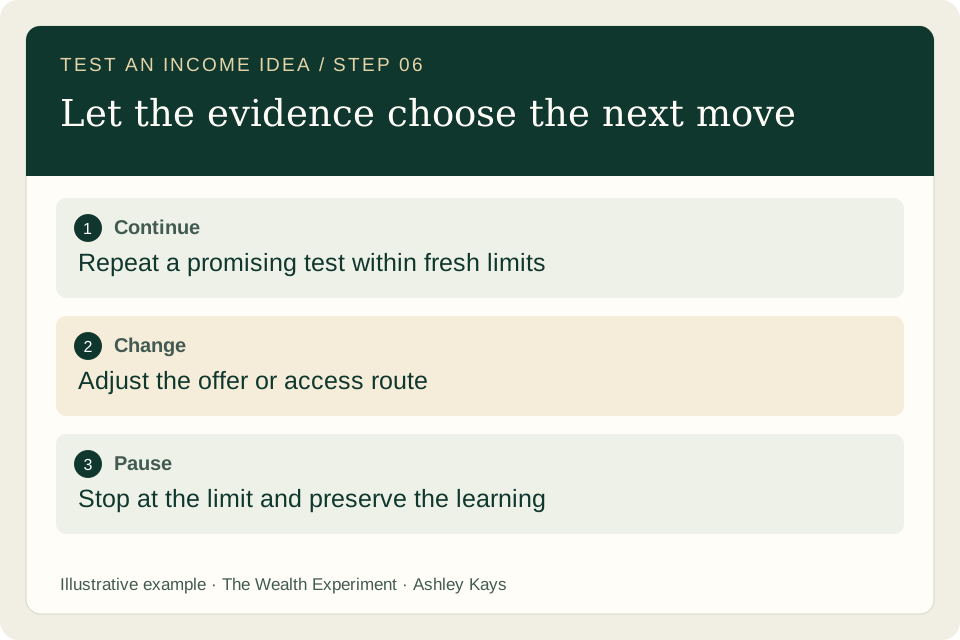
Compare the evidence with your original rule, explain what remains unknown, and choose the next move. A useful experiment changes a decision.
What to do
- Review the original question, limits, and evidence rule alongside the dated log. Separate work completed, customer behavior, delivery quality, and economics so activity does not stand in for results.
- Consider alternative explanations. A weak channel, unclear offer, delayed buying need, or difficult delivery process may require a different next test; document which interpretation the evidence supports.
- Write a short decision memo: continue, change, or pause; why; what remains uncertain; and the next test or stopping point. Set new limits before beginning another round.
See what good work looks like
Three possible decisions, each grounded in evidence
Continue if the observed commitments and accepted delivery justify another bounded test. Change if relevant conversations reveal that organizing discovery notes matters more than drafting a proposal. Pause if you reach your limits without enough useful access or cannot deliver to the required standard.
These are possible interpretations, not reported outcomes. A small pilot informs the next decision; repeatable demand and dependable income require further evidence.
Copy the prompt for this step
Replace the bracketed details with your own project. Review what the assistant returns.
Use this original experiment card [card] and evidence log [log] to draft a decision memo. Distinguish observations, interpretations, and unknowns. Assess the preselected criteria, explain alternative causes, and recommend one bounded next test or a pause. Do not infer repeatable revenue from a small sample.
Before you move on
- The decision refers to the original test question.
- Alternative explanations and missing evidence are visible.
- The next action has a clear limit and review point.
Keep this output: A dated decision memo with the supporting evidence, unresolved questions, and next action.
If you get stuck: Do not keep adding features to avoid a difficult decision. Resolve the uncertainty that the current evidence actually exposes.
Make it yours
Prepare your first experiment for real feedback
Choose a service you could deliver with existing skills. Complete the experiment card before building the sample, then review the offer and outreach plan so your first conversation has a clear purpose.
Keep these deliverables
- One experiment card with a question, limits, and review date.
- One clearly labeled sample and a scoped offer.
- One appropriate channel and a reviewed invitation.
- One ledger for effort, costs, responses, and the final decision.
You are ready for the next step when…
- A relevant person can explain the proposed deliverable.
- Your next test addresses a specific uncertainty.
- You can record an honest outcome, including a decision to pause.
When the work gets stuck
People praise the idea but do not commit.
Make the deliverable and next decision concrete. Ask about timing, current alternatives, and what they would need to evaluate a pilot; keep compliments separate from purchase evidence.
The test reaches few relevant people.
Revisit your access route and audience fit. Record the distribution limitation before making conclusions about demand, and choose a realistic channel for the next test.
Delivery takes much longer than expected.
Find the work creating the overrun. Clarify inputs, narrow scope, improve the review process, or change the terms before accepting another engagement.
AI research produces confident but unsupported claims.
Ask for the original sources and inspect them. Remove claims that cannot be established, and convert the remaining uncertainty into a customer question or test.
Questions before you begin?
Do I need a website before testing an offer?
Often a clear document and representative sample are enough for an initial conversation. Build a page when it helps a relevant person understand or act on the offer.
Should my first pilot be free?
Choose based on the question. A free test can reveal usability or delivery issues, but it does not test willingness to pay. Explain the arrangement and avoid treating free participation as purchase evidence.
What if the first experiment does not work?
Record what happened, what it cost, and what you learned. Decide whether the evidence supports a different test or a pause. A bounded attempt can be useful without becoming an ongoing business.
Sources and further reading
These references support the workflow and learning principles. The worked examples and prompts above are original teaching material. Check product documentation for current screens and feature availability.
- Anthropic: choosing simple workflows and evaluating their results ↗
- U.S. Small Business Administration: customer research and business planning ↗
Guide updated October 25, 2026 · Ashley Kays · The Wealth Experiment